
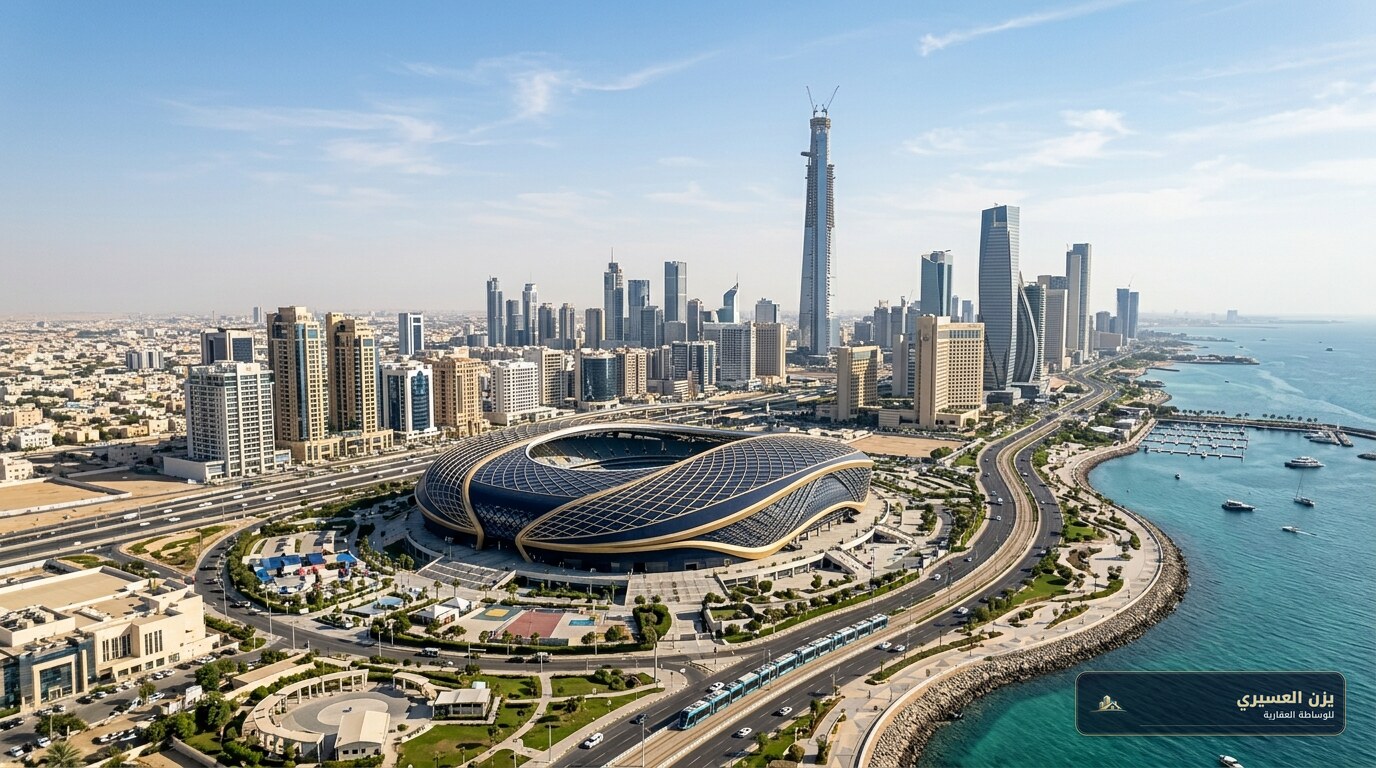
Saudi Arabia's selection to host the FIFA World Cup 2034™ represents a significant milestone in the Kingdom's ongoing sports, tourism, and urban development. FIFA officially announced in December 2024 that the Kingdom was chosen to host the tournament, making the 2034 edition the first 48-team World Cup to be hosted by a single nation.
The impact of a global event of this scale extends far beyond stadiums and matches; it is directly linked to the development of facilities, transportation, hospitality, services, and the urban areas surrounding event sites. The city of Jeddah stands out among the host cities included in the Kingdom's bid, leveraging its coastal location on the Red Sea, an international airport, an extensive road network, tourism facilities, and multiple urban projects.
From a real estate perspective, this raises an important question: How will the transformations associated with World Cup 2034 reflect on the future of Jeddah and its real estate market?
Jeddah in the World Cup 2034 Bid
According to the official website of the Saudi FIFA World Cup 2034, the hosting strategy relies on 15 proposed stadiums across five host cities: Riyadh, Jeddah, Al Khobar, Abha, and NEOM. This includes existing venues undergoing redevelopment as well as others currently under construction or planned.
Jeddah holds a vital position within this plan, with its bid featuring four tournament-related stadiums, along with proposed facilities and venues for fan events, plus a transportation network to serve visitors and fans.
However, it is important to distinguish between current assets and future plans; the four stadiums are not all operating today in the exact form anticipated for 2034.
Jeddah Stadiums in the World Cup 2034 Bid
King Abdullah Sports City Stadium
King Abdullah Sports City Stadium, famously known as The Shining Jewel, is the most prominent existing venue among Jeddah's sites. Opened in 2014, the hosting bid includes plans for its renovation to meet FIFA requirements while preserving its distinctive architectural features.
According to the official bid, its target capacity exceeds 58,000 spectators, and it is proposed to host matches up to the quarter-finals.
From a real estate standpoint, having a major existing sports facility differs from developing a brand-new site; the potential impact is more closely tied to enhancing surrounding services, roads, utilities, and improving overall accessibility to the area.
Qiddiya Coast Stadium
Qiddiya Coast Stadium is a new stadium planned for construction as part of the Qiddiya Coast project on the Red Sea shores.
The official website indicates that the project will include sports facilities and hotels alongside the stadium, with a planned capacity exceeding 46,000 spectators.
From a real estate perspective, integrated developments combining sports, hospitality, and entertainment can create an impact that lasts beyond the event days, especially if they transition into sustained destinations for business, tourism, and leisure after the tournament.
Central Jeddah Stadium
Central Jeddah Stadium is among the venues listed in the bid, planned for construction within Jeddah's sports park district.
The announced design draws elements from the architectural styles of Historic Jeddah (Al-Balad), surrounded by dedicated fan zones, with a planned capacity exceeding 45,000 spectators.
This project carries particular significance due to its integration with the broader urban transformation taking place in Central Jeddah. From a market perspective, developing mixed-use districts that blend residential, commercial, entertainment, and public spaces can shape future living patterns, traffic flow, and demand for surrounding services.
King Abdullah Economic City Stadium
The bid also includes King Abdullah Economic City Stadium, a new stadium scheduled for construction in King Abdullah Economic City along the Red Sea coast.
The bid presents a multi-use design inspired by local coral reefs, with a planned capacity exceeding 45,000 spectators.
This venue extends the hosting footprint into the area surrounding Jeddah. However, it should not be viewed as an automatic guarantee of rising property values between Jeddah and KAEC; real estate dynamics are influenced by multiple variables and cannot be attributed solely to a single event.
How Might Tournament Preparations Impact the Real Estate Sector?
There is no rule stating that hosting a global tournament automatically increases all property prices. The impact varies across different districts and real estate asset classes. However, several key factors are worth monitoring in the years leading up to 2034:
- Infrastructure and Accessibility: Transportation networks, roadways, parking capacity, and airports become critical when hosting large volumes of visitors. As an area's accessibility improves and connects better to employment hubs, services, and entertainment, it becomes more attractive for residential or commercial use. However, real estate investors should distinguish between officially announced projects and unverified rumors or speculative concepts.
- Hotels and Serviced Apartments: The hospitality sector is directly tied to major international events. Increased tourism and sports travel can drive demand for hotels, serviced apartments, and lodging facilities, particularly in locations with direct access to stadiums, the airport, and entertainment hubs. Nevertheless, the investment feasibility of any hospitality project depends on occupancy, operational costs, licensing, location, and management—not solely on the World Cup.
- Commercial Real Estate: Developing destinations that attract visitors can generate opportunities for commercial activities such as restaurants, retail, services, and entertainment. While certain zones may benefit from higher foot traffic and economic activity, this does not mean every commercial property near a planned site will be a guaranteed success.
- Residential Units: Giga-projects can foster the rise of new urban communities or elevate service standards in existing neighborhoods. Over time, demand across specific districts may shift, particularly where road connectivity, services, schools, utilities, and job opportunities converge. Evaluating an apartment or villa for investment requires analyzing the specific neighborhood's market fundamentals rather than relying solely on proximity to a World Cup site.
Is World Cup 2034 an Opportunity for Real Estate Investors in Jeddah?
World Cup 2034 can be viewed as one driver within a larger urban development trajectory in Jeddah, rather than a standalone reason to purchase real estate.
Long-term real estate investors should track infrastructure progress, project delivery phases, zoning changes, supply and demand dynamics, and new community amenities.
It is equally essential to consider acquisition costs, financing terms, maintenance, projected yield, liquidity, and regulatory or market risks. Crucially, properties should not be purchased based on speculative claims like "this area is guaranteed to surge because of the World Cup," as such outcomes cannot be guaranteed.
Real estate investment is an independent financial decision requiring careful evaluation of each asset and scenario. The information in this article does not constitute a recommendation to buy or sell real estate, nor does it guarantee future returns.
From 2026 to 2034: Monitoring Is More Important Than Speculation
With several years remaining before the tournament, project details, timelines, and operational plans may evolve during execution. Industry stakeholders are advised to rely on official channels rather than base decisions on circulating renderings or unverified media. Evolving project details require continuous verification through official sources as development progresses.
The 2034 World Cup bid provides a clear view of core venues and master plans, but actual execution over the coming years will define the specific urban and economic impact on each area. For Jeddah, the significance of the upcoming period is driven not by a single event, but by a comprehensive wave of development, tourism, hospitality, and infrastructure projects currently underway or planned.
Jeddah Real Estate and the Next Phase
Jeddah is undergoing significant urban transformation, making market tracking essential for property owners, investors, and tenants alike.
While World Cup 2034 may accelerate certain developments and preparations, the true value of any property remains grounded in its location, asset class, project quality, surrounding infrastructure, and actual market demand.
Through Yazan Al-Asiri Real Estate, you can explore the latest opportunities across Properties Page available listings in Jeddah, or submit a custom property request tailored to your requirements. Our team also welcomes you to Contact Page connect with us to assist you and verify property data and regulatory requirements prior to closing any transaction.
"AI-generated illustrative image for editorial purposes; does not represent the official design or location of any World Cup 2034 stadium."
Comments